Words have shaped the story of human rights for centuries. A single sentence in a speech, a letter, or a founding document has sometimes changed how millions of people see freedom and fairness. If you are looking for human rights quotes to inspire a speech, a school project, a social media post, or your own reflection, this guide has you covered.
Below you will find some of the most meaningful quotes on human rights, who said them, and why they still matter. You will also find practical tips for using them well, with context and respect.
Featured image idea: A hand holding a lit candle against a dark background, with a world map softly glowing behind it.
What Are Human Rights Quotes?
Human rights quotes are short, memorable statements about the basic rights and freedoms every person is entitled to, simply because they are human. These include the right to life, liberty, equality, education, a fair trial, and freedom from torture and discrimination.
The quotes come from many places:
Activists and campaigners
Political leaders and diplomats
Writers, poets, and philosophers
Survivors of injustice
International documents such as the Universal Declaration of Human Rights
A good human rights quote does more than sound beautiful. It makes people stop and think. It names a problem, defends a principle, or calls for action.
Why Do Human Rights Quotes Still Matter Today?
Human rights are not a finished project. Around the world, people still struggle for fair treatment, safety, education, and a voice in the decisions that affect their lives. Quotes matter for three reasons.
They make big ideas easy to remember. Legal documents can be long and technical. A single line can carry the same message in a way anyone can understand.
They connect us across time. When you read words spoken decades ago that still apply today, you see that the struggle for dignity is shared across generations.
They move people to act. Many movements have been held together by a few strong words repeated at marches, in classrooms, and around kitchen tables.
Human Rights Day is observed every year on December 10, marking the day in 1948 when the United Nations General Assembly adopted the Universal Declaration of Human Rights. It is one of the most popular times to share inspiring quotes about human rights.
Famous Human Rights Quotes From the Universal Declaration
The Universal Declaration of Human Rights (UDHR) is the foundation of modern human rights thinking. It contains 30 articles, and its opening line is among the most quoted in the world.
“All human beings are born free and equal in dignity and rights.”
— Universal Declaration of Human Rights, Article 1
This sentence captures the core idea in plain words. Rights are not gifts from a government. They belong to every person from birth.
The UDHR was drafted under the leadership of Eleanor Roosevelt, who chaired the UN Commission on Human Rights. She also left one of the most loved quotes on the subject:
“Where, after all, do universal human rights begin? In small places, close to home.”
— Eleanor Roosevelt
Her point is simple and powerful. Human rights are not only about courts and treaties. They begin in how we treat our neighbors, coworkers, classmates, and family.
Inspirational Human Rights Quotes From Leaders and Activists
Nelson Mandela
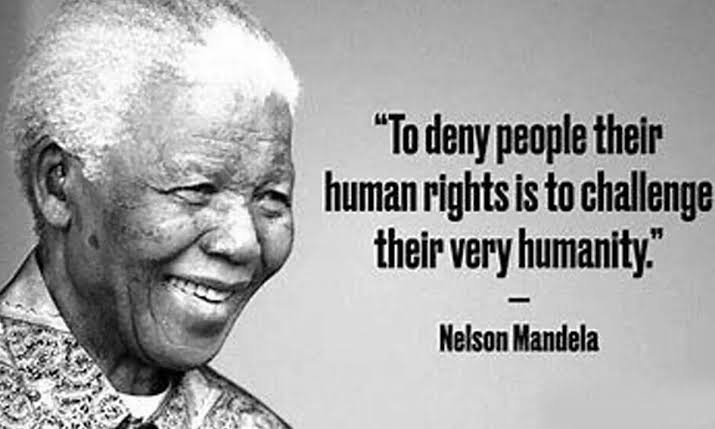
Mandela spent 27 years in prison for opposing apartheid, then became South Africa’s first democratically elected president. His words carry the weight of lived experience.
“To deny people their human rights is to challenge their very humanity.”
“To be free is not merely to cast off one’s chains, but to live in a way that respects and enhances the freedom of others.”
The second quote reminds us that freedom is not only personal. It comes with a responsibility toward other people.
Martin Luther King Jr.
King’s leadership in the American civil rights movement made him one of the most important voices for equality in history.
“Injustice anywhere is a threat to justice everywhere.”
“The time is always right to do what is right.”
The first line comes from his Letter from Birmingham Jail. It explains why people far from a problem should still care about it.
Malala Yousafzai
Malala became a global symbol of the right to education after surviving an attack for speaking up for girls’ schooling. In 2014 she became the youngest person ever to win the Nobel Peace Prize.
“When the whole world is silent, even one voice becomes powerful.”
Desmond Tutu
The South African archbishop and anti-apartheid campaigner is widely credited with this line:
“If you are neutral in situations of injustice, you have chosen the side of the oppressor.”
Elie Wiesel
Holocaust survivor and Nobel laureate Elie Wiesel spoke often about the danger of silence.
“We must take sides. Neutrality helps the oppressor, never the victim.”
Kofi Annan
The former UN Secretary-General described human rights in a way that is both practical and moral.
“Human rights are what reason requires and conscience demands.”
Frederick Douglass
Born into slavery, Douglass became one of the most powerful voices for abolition.
“I would unite with anybody to do right and with nobody to do wrong.”
Human Rights Quotes by Theme
Different situations call for different words. Here is a quick guide to choosing the right quote for your purpose.
Quotes About Equality and Dignity
Use Article 1 of the UDHR when you want a clear, universal statement.
Use Mandela’s line about humanity when discussing discrimination.
Quotes About Justice and Speaking Up
Use King’s “injustice anywhere” line to explain why distant problems still matter.
Use Tutu or Wiesel when writing about silence and neutrality.
Quotes About Education and Youth
Use Malala’s words when talking about girls’ education or young voices.
Pair her quote with a short note about why education is itself a human right.
Quotes About Everyday Action
Use Eleanor Roosevelt’s “small places, close to home” line when encouraging people to act locally.
How to Use Human Rights Quotes Effectively
A strong quote can lift your writing, but only if it is used with care. Follow these steps.
Choose a quote that fits your message. Do not pick one just because it is famous. It should support your point.
Name the speaker correctly. Misattributed quotes are common online. Check the source before you publish.
Add context. One or two sentences about who said it and why gives the quote real meaning.
Explain it in your own words. Tell the reader what the quote means to you or why it matters now.
Keep it short. A single sentence usually works better than a long passage.
Pair words with action. Mention a way readers can help, such as supporting a local rights group, volunteering, or learning more.
Best Places to Use These Quotes
Speeches and school presentations
Essays and research papers
Blog posts and newsletters
Social media captions and graphics
Posters for Human Rights Day events
Classroom discussions and assemblies
Common Mistakes to Avoid When Sharing Quotes
Trusting unverified sources. Many quotes online are credited to the wrong person. If you cannot find the original speech, book, or document, say “attributed to” or choose another quote.
Using quotes without context. A powerful line placed on an image with no explanation can lose its meaning, or even be twisted into something the speaker never intended.
Overloading your article. Five quotes in one paragraph weaken each other. Give every quote room to breathe.
Ignoring the issue behind the words. Sharing a quote about equality while ignoring real problems around you can feel empty. Let the words encourage genuine reflection.
Changing the wording. Do not shorten or rewrite a quote to fit a design. If you must cut it, make that clear.
Tips for Writing Your Own Human Rights Message
Sometimes the best words are your own. If you want to write an original message, try these ideas:
Start with a real moment, such as something you saw, read, or experienced.
Use simple language. The most memorable lines are rarely complicated.
Focus on one idea, such as dignity, fairness, or courage.
Speak to the reader directly with words like “we” and “us.”
End with a clear call to think or act.
Frequently Asked Questions About Human Rights Quotes
What is the most famous human rights quote?
The best-known line is probably Article 1 of the Universal Declaration of Human Rights: “All human beings are born free and equal in dignity and rights.” Many people also cite Martin Luther King Jr.’s statement that injustice anywhere threatens justice everywhere.
Who wrote the Universal Declaration of Human Rights?
A committee drafted it, and Eleanor Roosevelt chaired the UN Commission on Human Rights that guided the work. The UN General Assembly adopted it on December 10, 1948.
What are some short human rights quotes for social media?
Short options include Mandela’s “To deny people their human rights is to challenge their very humanity” and Malala’s “When the whole world is silent, even one voice becomes powerful.” Both fit easily into a caption or graphic.
When is Human Rights Day?
Human Rights Day is observed every year on December 10 to mark the adoption of the Universal Declaration of Human Rights.
How can I make sure a quote is accurate?
Look for the original speech, book, or official document. Reliable sources include UN websites, major libraries, and established news archives. If you cannot confirm the source, avoid presenting the quote as certain.
Can I use human rights quotes in school or work presentations?
Yes. Short quotes with proper credit are normal in presentations. Always name the speaker and, where possible, the source.
Why should we teach human rights through quotes?
Quotes give students an easy way into big topics. A single line can start a discussion about fairness, courage, and responsibility, which can then lead to deeper study.
Conclusion
Human rights quotes are more than decoration for a speech or a social media post. They carry the experience of people who stood up for dignity, sometimes at great personal cost. From the opening line of the Universal Declaration to the words of Mandela, King, Malala, and Eleanor Roosevelt, these statements remind us that rights begin with respect for every person.
The next time you share one, take a moment to check its source, add context, and connect it to the world around you. As Roosevelt suggested, the story of human rights is written in small places, close to home. Your words, and your actions, are part of it.